
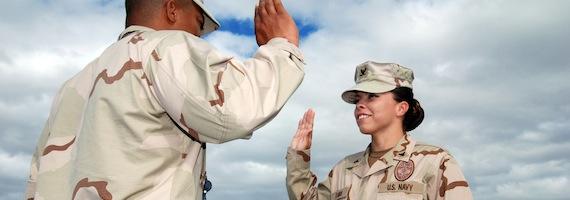
Your sailor comes home with IA orders. Yet you have never even heard of an IA. Don’t worry. There are only about 100,000 Individual Augmentees (IA) who have filled this billet throughout the entire Navy.
Navy IA service members are reassigned from their parent Navy command for six months to a year or more with, typically, an Army Battalion in Iraq or Afghanistan. Yes, that means Sailors in the desert!
IA troops and their families are under some very unique pressures. Changing your strategy to suit the current deployment is something Navy families do all the time. Instead of expecting the entire ship or squadron to deploy, this is a deployment your family mostly handles independently. It takes a little more self-awareness and self-motivation than usual. Here are a few proven MUST DOs that have come directly from former IA families.
1. PREPARE – Take the time as a family to go over the IA paperwork together. Build a plan as a team. Even if you have always been pretty independent about deployments in the past, attend informational meetings for resource ideas and to meet others like you. The extra effort is worth it.
2. COMMUNICATE – Be more open to talking about any changes, expectations, difficulties and triumphs with your service member. An IA tour offers an opportunity for growth in your relationship. Creatively develop new and fun ways to stay in touch (journals, cards, and letters). Always remember OPSEC on the phone, Skype and Facebook. Understand that there are some difficulties that should not be discussed during a combat deployment.
3. RESOURCES – Find resources and ombudsman information for your parent command and your IA command and have it handy before you actually need it. If in doubt, try MilitaryOneSource.com, FocusProject.org, RealWarriors.net, or search 211 in your area for your own community resources. Also, search on SpouseBuzz.com to see how others have handled a particular issue.
4. BUILD A SUPPORT NETWORK – Often other family members from your IA’s new command are hundreds of miles away. Friends, family and others within the local community can be great assets during deployments. Understand the deployment cycle (pre-deployment, deployment, post-deployment, reintegration, and re-deployment) and prepare your support network on what to expect during each phase.
5. FIND OTHERS – Your parent Navy command may try to touch base with you during deployment, but IA families report that this is rarely enough. Look for other IA families that can understand these unique challenges. NavyIAFamily.com is a great new online resource specifically for this reason. Also reach out to your service member’s new Army or Marine unit. Even if you are too far away to attend events, getting ombudsman emails and Facebook updates from those who are also going through deployment really helps.
As always, continue to take care of yourself and your family, don’t be afraid to ask for help, and never think that you are alone. YOU ARE NOT ALONE!
About Laura Oakley: I am a Navy spouse with a background in Psychology and Social Welfare. I am committed to ensuring that our IA families are taken care of. Please check out http://www.navyiafamily.com/ and participate in our new project called Operation: I Have A Voice






Comments
This is a great list. My husband was an IA recently. One issue that is little known in the community- when a sailor is IA, his/her original command ombudsman is supposed to support the family, not the ombudsman for the IA command (I was an ombudsman for an IA command, which is how I know). I was constantly referring families back to their original command for assistance.
I guess that I do not fully understand, isn't it the job of all Ombudsman to help ANYONE and EVERYONE who calls looking for help and not just pass them off to someone else? I am just trying to understand so that we don't waste valuable time. Thanks.
Well, absolutely you are right. And if someone called looking for something simple like a phone number for a resource, I was happy to oblige. However- as ombudsman for the IA command itself (the place in charge of all the thousands of IA's in a region) I didn't even have access to the names of the IA sailors, or know what commands they came from. (I was only the ombudsman for the sailors that were assigned to that command, not the IA sailors. ) So if a spouse needed something that involved knowing personal information, they would have to call the parent command. Luckily there is often a Family Readiness Department attached to IA commands, and they help with finding the correct ombudsman to call. The other reason to stay with the parent command ombudsman is that they often already have a relationship with the family that went IA, so there is a familiar person to deal with. I don't mean to sound like ombudsman aren't supposed to help certain people- just that there is already a procedure in place that most commands and even some ombudsman are not aware of, that is there for a reason. Hope that makes sense. It was a confusing situation to be in myself, as I have been on both sides.
Erika: I'm really glad you are replying to this post. I often wonder how IA families get so isolated. Understanding all the rules you ombudsmen (FROs, FRG leaders) are subject to is enlightening.
Why are IAs so isolated? One ingredient is incompetence. The Navy has documented cases of dropping the ball on many IAs and much of the current Navy assistance comes from those who know little about IA combat deployments. Clearly, everyone’s IA experience is VERY different. For those who have had a recent IA experience, support may be wonderful, but for those early IAs or many in direct combat roles, there is no such thing as informed assistance. Let’s be honest, few active duty IA families get much for support. In my experience, most active duty do not even know who their Navy ombudsman is because it changes too quickly due to gossip, incompetence, neglect or down-right stupidity (disobey OPSEC rules).
Three options for military support, if you are lucky: the Navy command, Fleet and Family Services, and/or the IA command (Army, Marine, or other).
Save your family a whole lot of grief and find resources outside of the Navy. There is help outside of the military. Search for it. Most organizations operate with little politics and even less red tape.
We had a specific IA Ombudsman when my husband deployed (he JUST got back from his IA). The IA ombudsman contacted us once a month either by phone or email (our choice), sent a monthly newsletter and there was a monthly activity for us to attend if we wanted to which was usually a free dinner and something fun like bowling. My husband’s command’s ombudsman offered her assistance as well and even had us over for dinner one night. The command itself made sure I was invited and given free tickets to the Christmas party and free childcare if needed. They also all donated money and gave us a nice gift card for a fun resteraunt. (any dinner that I didn’t have to cook and wash dishes was a HUGE blessing while he was gone).
Overall our IA experience was a good one. We had all the normal stress and worry and we had extra due to where he was going but I must admit the Navy actually did right by us when it comes to offering family support and ensuring we still felt attached to his home command.
My hubby has deployed IA twice through his AF Command. He also happens to be a Reservist. Unfortunately I had no contact with any military personnel during either deployment. We went through both deployments utterly in a vacuum. Had there been an emergency, I had a contact name and number at his base but that was it. I had no idea if the name and number would even have been correct. No one from the military ever called to check on how things were going, not one word. Fortunately, we survived it all on the basis of our own wherewithall.
Deb, so sorry to hear that your family was so isolated. You're not the only one who has survived a situation like that! Would you/your spouse be willing to be interviewed about your IA experience? NavyIAFamily.com has a project called Operation I Have A Voice, which begins 01 August. We are conducting interviews with IA families about their experience in order to gather ideas to better the system and to document this unique deployment style. Everything will remain classified. If your interested check out the website (www.navyiafamily.com) or email navyiafamily@gmail.com.